
SURVEILLANCE LANDSCAPE
You’re a person, not a product
The Players
Law Enforcement
Local police
ICE, FBI and others
Cybercriminals
Black-Hat hackers
Identity thieves
Black market brokers
Tech and Retail
Ad-tech business
Advertisers/brands
Data brokers
Reality Check
In 2025, the U.S. hit a record 3,322 data breaches, an impressive 79% jump over five years. (1) As a statistic it’s impressive, but meaningless to most of us. Yes, government and big business still aren’t sufficiently securing our data, cybercriminals still have the upper hand, and all we can do is shrug our shoulders and move on… right?
Turns out we’re not powerless, and taking control is worth the effort.
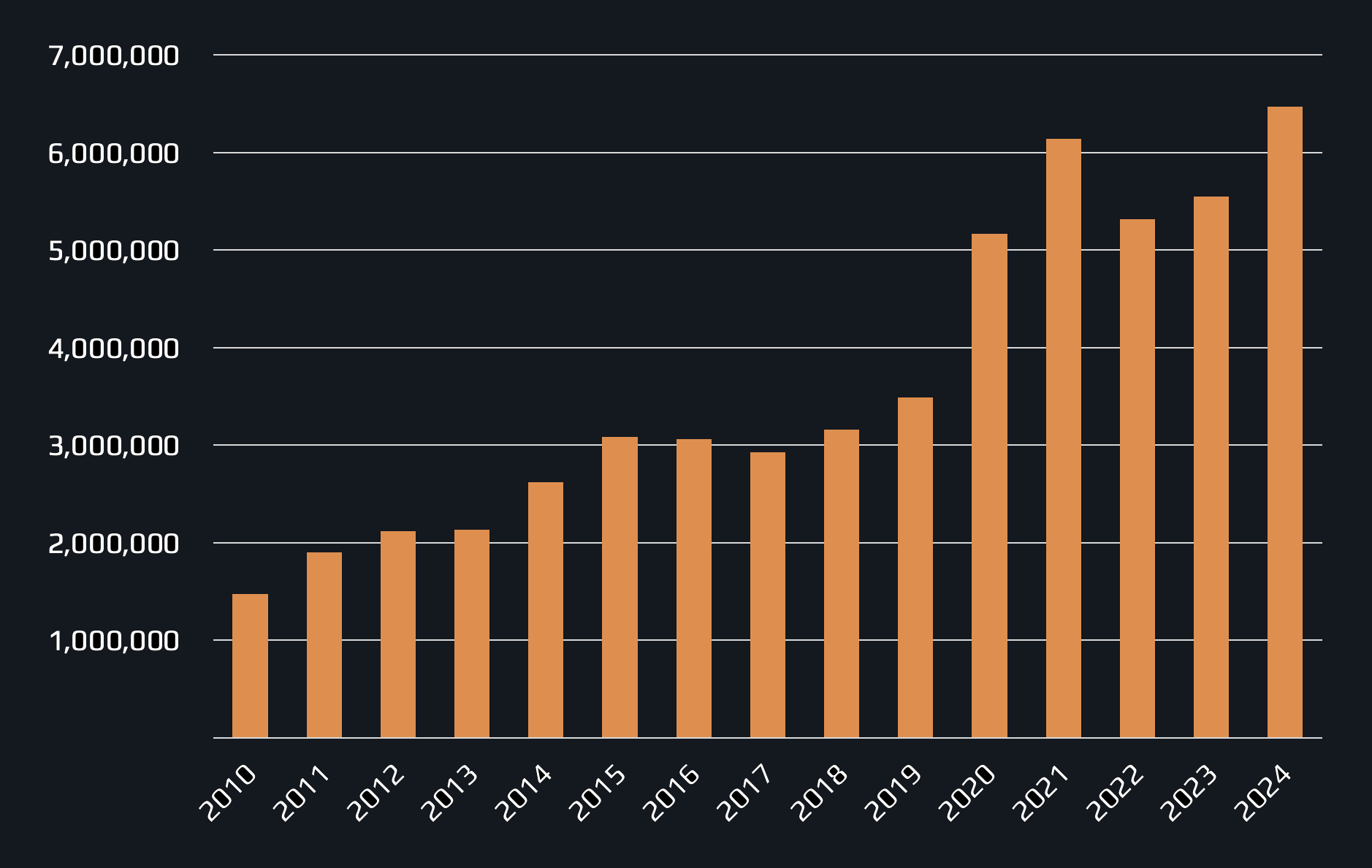
Take a look at this chart—a clean trend showing remarkable increases in reports of fraud and identity theft. In 2024, that’s one report for every 39 adults in the U.S. (2) We can only observe passively until the problem affects us directly. (3)
Fraud, Identity Theft, and Related Reports (FTC)
Your personal data is worth a lot to anyone who can analyze, sell, or otherwise profit from it. Law enforcement, data brokers, social media, retailers, and ad networks are all exploiting your identity. (4)(5)(6) They silently, conveniently drive you to complacency and consumerism. If this sounds like cyber-punk, dystopian corporatocracy to you, you’re not alone.
It’s giving NPC energy, y’all.
But your personal story isn’t inevitably noir.
Digital sovereignty isn’t about going permanently offline or hiding in paranoia. It’s about bringing your digital identity to awareness, and creating a hygiene routine that invites intention and control. By confronting the spaces we avoid, we gain confidence to move through life with personal authority. Now more than ever people are taking action. With all this mess of scams and data breaches, more than half of us have begun the journey of protecting our personal information. (7) It’s your turn to pick up the torch. We don’t play into corporate fear, we embrace informed defiance.
Like a dentist who encourages you to start flossing long before infection, I’m here to tell you it’s time to pay attention.
Impact
Data brokering is a growing, 331 billion-dollar industry (1), fed by a constant stream of personal data that you are unknowingly—yet freely—handing over. (8) Your location, online and in-store purchases, search and web browsing history, social media interaction, and more are studied and scrutinized to predict your behavior for maximum profit. Who you’re with, who your family and friends are, your routines, politics, income, gender, vices, religion, age, location, medical conditions — all revealed, scored, shared, sold, and exploited. (9)
You don’t notice all of this happening; you’re not supposed to. You might once have said something out loud and seen an ad for it shortly after. It may lead you to believe that your phone is actively listening to your conversation. While that’s not impossible, let me assure you—it doesn’t need to. What you’re experiencing is the disconnect you have from just how much these networks know about you and read you like a book. (10)(11)
The cost and scope of data breaches are at all-time highs. (12) Having all of this personal information in the hands of tech companies makes phishing, fraud, and identity theft an even greater risk than before. But it goes beyond that, law enforcement, government agencies, insurance companies, and others are also big buyers of personal info, including transaction and location data. They’ve used this data to track protesters, raise insurance premiums, or deny loans. (13)(14)(15)
Direct Attack
Identity theft: Fraudsters can use your data to open new bank accounts, max out existing cards, file bogus tax returns, or even rent apartments in your name. The financial damage runs into thousands, and rebuilding trust with lenders can take years.
Phishing/Scam targeting: Scammers who purchase hacked data on the dark web can more convincingly trick you into believing they’re legit when they present you with your own personal data in an email or phone call.
SIM Swap: Hackers will use your personal data to take control of your phone number by duping your cell phone provider into giving them access. This allows them to intercept login codes that can log them into other online accounts you own.
High-profile spear phishing: Someone trying to extort or blackmail you could use transaction and account data to track your habits and routines and discover protected traits. Journalists and other high-profile individuals are often targeted in this way, but if your stalker ex knows what they’re doing there are plenty of sites that will provide them valuable info.
4th Amendment violations: Access to data brokers and tech companies means law enforcement and government agencies can collect data on you, including location history, camera footage, and transactions—performing deep investigations, especially if you’ve been to a protest or politically active online, and often without a warrant.
Unseen Cost
Price discrimination: You could be shown higher prices on flights, hotels or other services if you’re using a high-end phone or have a high income.
Insurance Premiums: Health data (even inferred from what you buy or search) can impact how much you pay for health insurance.
Employment: Some background check services use social media scraping and data points to “score” candidates before they’re considered for an interview.
Credit: Data brokers’ profiles on you can influence how lenders perceive your reliability.
Echo chambers: Social media platforms designed to maximize engagement use what they know about you to evoke the most powerful emotions—whether it be anger, fear, or even joy and excitement. As you play into your customized algorithm, you see the world less as it is, and more as whatever gets you worked up the most.
References
(1) Data Broker Market Report 2026
(2) FTC Data Sets
(3) People Who've Had Their Identity Stolen Are Sharing Their Experiences And It's Mildly Terrifying
(4) Ring killing Flock deal exposes the trust problem in AI-powered home security
(5) Data Broker Helps Police See Everywhere You’ve Been with the Click of a Mouse: EFF Investigation
(6) The new data brokers: retailers, rewards apps & streaming services are selling your data
(7) DBR 2025 Data Breach Report
(8) We Read 150 Privacy Policies. They Were an Incomprehensible Disaster.
(9) Data Brokers and Data Breaches
(10) Is My Phone Listening in? On the Feasibility and Detectability of Mobile Eavesdropping
(11) Privacy is the New Luxury: Are Our Smartphones Listening to Us?
(12) 110+ of the Latest Data Breach Statistics to Know for 2026 & Beyond
(13) Closing the Data Broker Loophole
(14) Data Broker Helps Police See Everywhere You’ve Been with the Click of a Mouse: EFF Investigation
(15) Don’t be surprised that the FBI is buying your location data